
MECHANICAL DESIGN · GENERATIVE DESIGN · FEA
DRONE
RACING
Development of a lightweight racing-drone structure using Autodesk Fusion 360, progressing from an initial CAD concept through generative design and FEA to explore the balance between structural integrity and mass reduction.
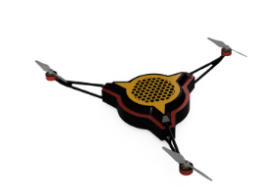
DESIGN OBJECTIVE
LIGHTWEIGHTING A RACING DRONE
This personal project developed from an interest in drones and provided an opportunity to extend my CAD skills into generative design. The main objective was to maximise structural stiffness while keeping component mass to a minimum.
The project was also used to develop my understanding of how structural requirements and weight efficiency can be considered together rather than treating lightweighting as a purely geometric exercise.
DESIGN APPROACH
Develop an initial conventional drone-frame concept.
Define the structural regions and interfaces required by the design.
Use generative design to explore a more mass-efficient structure.
Assess the resulting concept using finite element analysis.
INITIAL CONCEPT
PRIOR TO GENERATIVE DESIGN
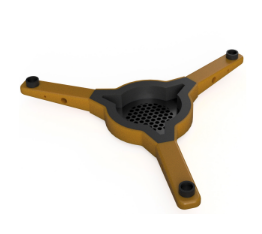
The project began with a conventionally modelled three-arm drone frame. This established the overall architecture, central body and motor mounting locations before introducing generative design.
Creating this baseline model provided a clear foundation from which the structure could be reconsidered, while retaining the interfaces and functional regions required for the complete drone.
GENERATIVE DESIGN
REDUCING MASS WHILE RETAINING STRUCTURE
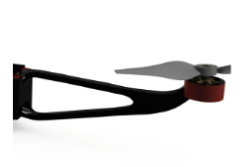
The initial geometry was then developed using the Generative Design workspace in Fusion 360. The aim was to remove unnecessary material while preserving the functional connections required between the central body and the motor locations.
This stage introduced a different approach to CAD development: rather than defining the final form directly, the design process was driven by the structural requirements and the need to achieve a lighter component.
SYSTEM INTEGRATION
FROM STRUCTURE TO COMPLETE DRONE
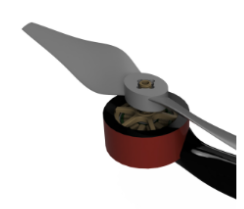
The generated structure was developed into a complete drone assembly to check how the lightweight frame interacted with the motors, propellers and central body.
Viewing the design as a complete assembly helped ensure that the structural concept remained compatible with the hardware it was intended to support, rather than existing only as an isolated optimisation result.
STRUCTURAL ASSESSMENT
FEA OF THE GENERATIVE DESIGN
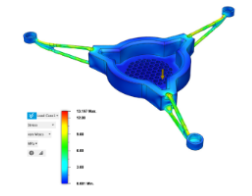
Finite element analysis was used to assess the generative structure and provide a visual indication of its response under the applied loading conditions.
This allowed the lightweight geometry to be considered from a structural perspective and reinforced the importance of balancing mass reduction with sufficient stiffness and strength for the intended application.
FINAL CONCEPT
LIGHTWEIGHT DRONE ASSEMBLY
The final assembly brought the generatively developed structure together with the drone hardware to produce a lightweight integrated concept.
The project demonstrated how conventional CAD, generative design and FEA can be combined within a single development workflow, with each stage informing the next rather than being treated as a separate exercise.
PROJECT OUTCOME
DESIGNING FOR MASS & STRUCTURAL PERFORMANCE
Developed an initial racing-drone structure and progressed it through a generative design workflow.
Used FEA to assess the generated structure and consider structural performance alongside mass reduction.
Integrated the lightweight structure with the motors and propellers to develop a complete drone concept.
This project developed my understanding of generative design and showed how CAD geometry can be driven by structural requirements rather than form alone. It also introduced me to a more integrated workflow combining concept design, lightweighting, FEA and consideration of additive manufacturing.